Home Blog Page 445

COVID-19: Over 2,000 cases reported today

0
Galway Daily news 25 percent drop in COVID cases in Galway hospitals

There have been a further 2,066 confirmed cases of COVID-19 reported by the Department of Health today.

As of this morning the number of people hospitalised with COVID in Ireland stood at 408, with 69 of them in the ICU.

There have been a total of 5,306 deaths related to COVID-19 in Ireland since the start of the pandemic.

This another 26 deaths which have been newly notified in the past week according to the Department.

Dr Ronan Glynn praised the level of vaccine uptake in Ireland, but cautioned that there is a “disproportionate impact” on hospitalisations and ICU admissions by people who have not been vaccinated.

“There has been fantastic uptake of COVID-19 vaccination over recent months,” Ronan Glynn said.

“Unfortunately, there are still just under 300,000 adults who have not come forward for vaccination and a further 70,000 people have received just one dose of a two-dose schedule”.

“The spread of disease in these 370,000 people is having a disproportionate impact on the profile of COVID-19 in our hospitals and intensive care units, with two out of every three people in intensive care not vaccinated.”

“Choosing to get vaccinated is an act of protection for yourself – it may save your life – but it is also an act of solidarity with others; the more of us that get vaccinated, the safer we all are.”

Ballinasloe native elected chair of Roscommon-Galway Young Fine Gael

0

Shane Brady of Killahornia, Creagh, Ballinasloe, has been elected chairperson of the Roscommon-Galway branch of Young Fine Gael at an online meeting.

Shane had previously held roles on the committee, and is looking forward to campaigning locally, nationally, and internationally on issues facing young people.

Shane Brady

The AGM was guest chaired by local Senator Aisling Dolan, Fine Gael Spokesperson on Education and Higher Education.

Speaking following the meeting, Shane said that he is delighted to be elected as chairperson of the local branch.

“I joined Young Fine Gael because the organisation has a long history of leading from the front in issues facing young people in Ireland, and it will be a huge honour to play a part in that,” he said.

“Joining Young Fine Gael was a great decision, and I would encourage anyone between the ages of 15-35 to consider joining via www.yfg.ie or by contacting the branch social media.”

Senator Aisling Dolan said that she looks forward to working with Shane and all the team in the Young Fine Gael branch.

“With my role on the Joint Oireachtas Education Committee and the first ever- Sub Committee for Mental Health, I am especially focused on young people and the impact of Covid-19 and the lockdown on education as well as the stress and pressure on wellbeing,” said Senator Dolan.

“We have worked very hard on the Cycleway campaign to encourage people of all ages in towns and villages make submissions across East Galway to showcase the excellent routes through Ballinasloe town for unique boglands, blueways, heritage, culture and sense of community.

“The selection of a preferred route corridor will be known by the end of October- mid November. This will transform life in our towns and villages in the West.”

Bus services essential for students due to housing crisis Canney says

0
Galway Daily news Additional Dog fines will have little effect without more Dog Wardens

Proper rural bus services are essential for students who can’t afford or find a place to live in the city where they go to college Galway TD Seán Canney has said.

Speaking in the Dáíl on the budget on Tuesday, Canney said that in many areas of East Galway, bus services are “being taken out of the equation” due to cancellations by Bus Eireann.

This causes problems for Galway students going to college in Galway City, Limerick, or Athlone, he added, since many can’t get accommodation there.

The services that do exist are “scrambling” to provide enough capacity Canney said.

Deputy Canney highlighted this by speaking about a young man who has to leapfrog from Tuam, to Athenry, to Limerick each day, by car, bus, and train, in order to go to college.

“One young man got a place in college in Limerick and has to get his parents to drive him to Athenry so he can get a train to Limerick. He then gets a bus from there to his college. He then has to travel back.”

“I understand he gets a bus from Athenry to Tuam and his parents pick him up. He does that every day of the week because he cannot get a place to live in Limerick,” Seán Canney said.

“He has bought a car and applied for a driving test, but will have to wait 15 weeks for it. They are the challenges our young people are facing when trying to access education.”

The Independent TD linked this to the increased carbon tax named in the budget, saying that it penalises people who have no choice but to travel by car, due to a lack of public transport.

“I know many people who would love to be able to take public transport or to take the bus into Galway to work from the east of the county.”

“They cannot do so because the service is not available or, when it is available, the bus lanes are not in place.”

Man walked in on Garda search with drugs on him

0
Galway Daily courts

A man who came home with drugs on him while Gardaí were searching the premises received a suspended sentence at Galway District Court.

Michael Toher (26), with an address at Tirellan Heights, Headford Road appeared before Judge Mary Fahy at Galway District Court in connection with €1,000 worth of cannabis and diazepam seized by Gardaí.

He pleaded guilty to two charges of possession of drugs with the intent to sell or supply them. Two other charges of simple possession were withdrawn by the state on his plea.

The court heard that on September 16 of 2019, Gardaí were searching Toher’s home in Tirellan Heights when he arrived at the house in possession of cannabis and diazepam, also known as valium.

The value of the drugs seized were €540 worth of cannabis, and €460 of diazepam. When questioned he admitted to Gardaí that the drugs were his.

Ms Olivia Traynor for the defence said that her client had drug addictions, and has been trying to get into treatment.

Judge Fahy imposed two six month concurrent sentences for drug offences, and suspended both of them for two years.

Budget 2022: Childcare providers say not enough done to address costs

0
Galway Daily news Budget 2022: Childcare providers say not enough done to address costs

Representatives of the childcare sector have said that Budget 2022 does not do enough to address costs for parents, or guarantee sustainability for service providers.

Childhood Services Ireland, the Ibec trade association for childcare providers, says that while subsidised hours of childcare, and expanded access to subsidised childcare for working families and unemployed people are welcome measures, they do little make childcare more affordable.

Budget 2022 announced that government investment in early learning and childcare sectors will grow to €716 million, which includes a €41 million increase to the core allocation to the sector, and a once-off boost of €37 million.

Minister Roderic O’Gorman said that this was the beginning of “transformative” multi-year investment programme that builds on their commitment to increase spending on the sector to €1 billion by 2028.”

Part of the childcare budget includes a new funding stream for service providers, providing them with support in return for a guarantee not to increase fees to parents.

This funding stream won’t come online until September 2022 however, with €69 million allocated for the measure for the months it is available next year.

There will also be an extension of the universal subsidy for the sector, allowing all children under 15 to receive a subsidy to offset fees.

Hours spent in pre-school or school will also no longer be deducted from the entitlement to subsidised hours, a move which is meant to benefit children from low income families whose parents are not in work or study.

Commenting on this, Childhood Services Ireland’s Director, Darragh Whelan, said; “Extending the amount of subsidised childcare hours does nothing for parents who can’t afford childcare in the first place.”

He said that what parents really need is universal subsidies, adding that waiting lists are already too long and that there aren’t enough places to meet demand.

The budget commits to retaining the exemption to the turnover rule for early learning childcare providers in the Employment Wage Subsidy Scheme until April 2022, after which it is expected that the EWSS created for the pandemic, will end.

From May to August 2022, service providers will have access to a once-off transition fund of up to €5.5 million per month in order to prevent the cost of additional health measures from being passed on to parents.

“The proposed funding for staff wages is welcome but the investment will have to be significant to reduce parental fees and ensure providers can afford to keep their doors open and the lights on,” Darragh Whelan said.

The Smoking Ban Examined: How Ireland Made History in 2004

0

In 2021, the world we live in is largely smoke-free. Unless you habitually carry a packet of cigarettes in your pocket, you’ll rarely see people lighting up. You can go for an evening out and never feel the cloying, smoky haze that once settled so familiarly in bars, pubs, and nightclubs.

Back in 2004, however, you’d probably have found this absence of cigarette smoke a lot more noteworthy. Cast your mind back to the early years of the millennium, and you’ll remember smoking in public was absolutely the norm.

Until, that is, Ireland made history.

Going smoke-free

March 29th, 2004 was the day Ireland underwent a fundamental change. It became the first nation in history to introduce a smoking ban in workplaces, but not everyone welcomed this. While the idea was to protect employees from the effects of second-hand smoke, many worried the social scene would be altered irrevocably.   

The ban was enacted in the space of a single night. Ashtrays disappeared from more than 10,000 pubs, clubs, and restaurants, while those caught smoking in public spaces were liable to be fined up to 3,000 euros.

The anti-smoking group ASH was vocal in its support, describing the ban as ‘the health initiative of the century’. The belief was that its enactment would not only reduce exposure to second-hand smoke but perhaps prompt social smokers to quit too. This hope proved well-founded: a 2014 study found the ban had saved an estimated 4,000 lives and encouraged thousands of smokers to successfully kick the habit.

Various methods were used to quit. Some went cold turkey, while others turned to options like very high nicotine pouches. This type of chewing tobacco was used by smokers to wean them off cigarettes while still delivering a nicotine rush or to provide a smoke-free substitute they could legally enjoy in public.    

History in the making

While Ireland may be a small country, in this respect it nonetheless proved the leader of the pack. Soon, many other countries followed in its footsteps, with Norway and New Zealand both enacting similar laws by the close of 2004.

The impact of this on public health was huge. It meant smoking became an active choice. Those who still wished to smoke were welcome to do so, but they were no longer breathing second-hand smoke on those who were worried about its effects. From Galway to Dublin, Kilkenny to Kinsale, smoking culture changed, but not in the negative way some had feared. Rather than becoming social pariahs, new outdoor areas were built with smokers in mind, showing that bars and eateries continued to embrace their custom.

Instead of proving divisive, the ban gave people countrywide the choice of how they wanted to live their lives. If they chose to smoke, they could do so in these specially designated areas; if they wished to stay smoke-free, they could go out and come back without the smell clinging to their hair and clothes.

It was a positive move for everyone and gave Ireland a chance to shine on the international stage for all the right reasons. 17 years later, and we’re still proud to have been a part of a cultural shift that benefitted the health of so many.      

Galway Hooker to be named in honour of Rosabel’s Rooms

0
Galway Daily Galway Hooker to be named in honour of Rosabel's Rooms

One of the famed Galway Hookers, restored to pristine condition, is to be named next week in honour of the inspiring charity Rosabel’s Rooms.

The boat has been lovingly restored by Bádórí an Cladaigh, the Claddagh Boatmen and will be launched in the canal waters opposite Monroe’s Tavern.

The event will be accompanied by a short performance from renowned trad musician Sharon Shannon, and a light projection by Sound To Light.

Suzanne McClean, founder of Rosabel’s Rooms said “We are beyond proud and so very moved that our beautiful, sweet girl Rosabel is being honoured and remembered in this way, thanks to Peter Connolly and his friends at Badoirí an Cladaigh.”

Rosabel’s Rooms is a charity established by Suzanne McClean and Gary Monroe, in memory of their beloved daughter Rosabel who died suddenly and unexpectedly in April 2017 when she was just 16 months old.

The rooms that they provide in hospitals are family- focused bereavement suites, designed in collaboration with the design and Dignity project at the Irish Hospice Foundation.

The boat itself, a cleoiteog beag, was the first boat acquired by Bádórí an Cladaigh in 2008 and has been carefully restored to it’s original beauty.

The launch will take place next Monday, October 18 at 6:30pm, after which the boat will take its place on the water to become a shining light for future events in Galway’s West End.

Budget 2022: Greenway and pedestrian projects in Galway

0
Galway Daily news Budget 2022: Greenway and pedestrian projects in Galway

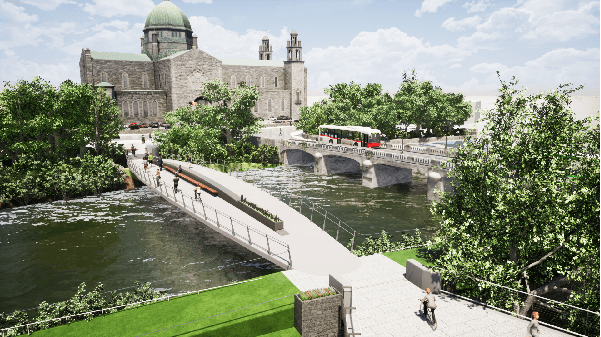
The Salmon Weir Pedestrian bridge, Martin Roundabout, and multiple greenways in Galway, are among the chief walking and cycling infrastructure projects targeted in the budget.

Budget 2022 includes €360 for walking and cycling infrastructure projects, including €60 million earmarked for greenways.

Among the key projects in this highlighted by the Department of Transport are the conversion of the Martin Roundabout in the city to a signalised junction, and the construction of the pedestrian and cycling bridge across the Corrib.

Galway TD and junior Minister Hildegarde Naughton said that this budget represents €1 million a day invested in walking and cycling infrastructure.

The three-span, 80m bridge across the Corrib was green-lighted by An Bord Pleanála back in August, and it is hoped construction will start early next year.

The bridge from Newtownsmith to Galway Cathedral/Gaol Road will reduce the level of pedestrians and bicycles on the old Salmon Weir Bridge, which was never designed for the amount of traffic using it daily.

Work on the €3.5 million Martin Roundabout by Galway Clinic into a signalised junction is also expected to begin by the end of November this year.

The transition is expected to make it safer for pedestrians and cyclists, as well as prioritising buses and provide greater access for Arduan, in order to facilitate the development of housing in the area.

Speaking at today’s press conference, Transport Minister Eamon Ryan said “Transport has a critical role to play in our daily lives, and how we travel has a direct bearing on our carbon emissions.

“By reorienting our investment towards walking and cycling, sustainable public transport in both urban and rural areas, and electric vehicles, we can make it easier for people to make changes that benefit us all.”

The Minister added that he was “particularly pleased” that there would be progress on greenways all over Ireland.

Among the greenway projects included in the budget are continue construction of the Connemara Greenway between Clifden and Recess.

The ambitious coast-to-coast Galway to Dublin greenway also gets a mention, with the construction of the greenway bridge in Athlone planned for the next year as part of the project.

Missing two-year-old Mayo girl found safe

0
Galway Daily news missing teen found safe

A Child Rescue Alert issued by Gardaí this evening for a 2 year old Mayo girl has been stood down as she has been found safe.

The girl has been located safe and well in the Dublin area.

Two adults, a man and a woman aged in their 30s, have been arrested in connection with this.

They are currently detained at a Garda Station in Dublin.

Gardaí thanked the public for their assistance, and said that no further information will be provided.

COVID-19: 1,466 cases reported today

0
Galway Daily news 25 percent drop in COVID cases in Galway hospitals

There have been a further 1,466 confirmed cases of COVID-19 reported by the Department of Health today.

As of this morning there were 402 people hospitalised with COVID in Ireland, of whom 73 are in intensive care units.

Deputy Chief Medical Officer Dr Ronan Glynn said “Over recent days we have seen an increasing number of people with COVID-19 admitted to hospital and to intensive care. ”

He said that roughly 70% of people being treated for the disease in an intensive care units are not fully vaccinated, which is a “cause for concern”.

“Vaccination, along with our continuing adherence to the public health advice, will break the chains of transmission and drive down incidence of COVID-19 in our communities.”

He reiterated advice that anyone who has symptoms should avoid going to work, school, college, or socialising.

Dr Glynn said that he would “strongly encourage” anyone who has yet to get the vaccine, to do so, and that anyone eligible for the flu vaccine should also get it.

Twelve local community festivals awarded funding by city council

0
Galway daily news Twelve local community festivals awarded funding by city council

Galway City will get to enjoy twelve community festivals in the coming months which have been approved funding by the city council.

The council advertised back in September for local communities planning small festivals in their area to apply for small scale grants to help bring them to life.

Of the €12,000 which was available through the Local Community Festivals Grant Scheme this year, €9,984 has been awarded for twelve events.

The purpose of this scheme is to support festivals or events which are organised and run by local residents as a way to reconnect the community in line with the next and final phase of the response to the COVID-19 pandemic.

The full list of festivals which are being supported by the city council is:

Name of Group / Organisation Purpose of Grant Grant Approved
Ballybane Taskforce


Launch of the Ballybane Community Café Space €564
Claddagh school of music


Live from Galway Community Christmas Concert €850
Coogan Park Residents Association


Coogan Park Community Memorial Day 2021 €800
Galway African Diaspora-Ireland


Galway Afrika Abu Festival €1,200
Galway Cycling Campaign


Galway Cross-City Community Cyclebus Event


€1,000
Galway Hooker Sailing Club


Community Festival for the launch of the ‘Loveen’ (restored Galway Hooker) €1,000
Galway Indian Cultural Community (GICC)


Christmas & New Year Community Celebration 2021 €1,000
Merlin Woods Allotments


Merlin Woods Allotments Harvest Event €500
Shantalla Community Allotments


Harvest Festival at Shantalla Allotments €370
Shining Light Galway


Shining Light Community Physical Health & Well-Being Saturday Series €500
Westside Arts Festival


Westside Christmas Concert


€1,200
Yoruba Heritage Art and Culture Afrobeat Music Festival €1,000
Total Amount Allocated  €9,984

Tips for Investing in a Down Market

0

What is going on with the stock market? The answer to that perennial question for late 2021 is, plenty, and most of it is not very good. But savvy investors know that as long as you can make a good guess about the direction of the securities markets, whether up or down, there’s a chance to earn a tidy profit.

Technology stocks, for example, are now at their lowest point since the first quarter of the year, and all the major players in the key indices took a huge beating in early October. Is there one reason for all the price drops?

Rarely does one factor cause such huge losses across the board. In the present case, it’s safe to say that there are at least two culprits: coming hikes in interest rates and creeping, slow but sure inflation. Add to that perfect storm the fact that there’s a current supply chain disruption around the globe while demand for consumer goods of all kinds continues to rise.

So, if you’re a careful investor, what are the opportunities these otherwise dismal situations present to you? How can traders use leverage, smart money management, inverse ETFs, bargain hunting strategies, blue-chips, and gold mining stocks as a work around?

Here’s a list of approaches that will no doubt become more popular as the inflation rate rises, supply chain problems worsen, and national banks in dozens of nations get ready to boost interest rates.

Leverage

For those who know how to cautiously use leverage trading, there are dozens of opportunities in a down trending economy. Leverage allows investors to put up just a portion of the total amount they place on a given transaction.

For instance, if your broker offers you 10:1 leverage, you only need to risk one-tenth the amount of the total purchase. That means you could buy 100 shares of ABC stock for the cost of just 10 shares.

The concept of leverage, and its power to magnify potential gains and losses, works in up and down market situations. So, you’re free to use things like inverse ETFs or funds that short entire exchange indices by putting up just a fraction of the total price of the assets you purchase.

Money Management

Another way to improve trading results is to practice wise money management. For many active investors, that means setting a hard limit on the amount of money they are willing to spend on a given transaction. One common technique is to never use more than two percent of your total available capital when buying a security.

Related techniques involve being very careful to diversify among sectors. This is why so many trading enthusiasts maintain portfolios that include shares of industrial, retail, financial, mining, health care, and other stocks. Rarely do all sectors rise or fall at the same time, so it’s a case of safety through diversification.

Inverse ETFs

Exchange traded funds offer people a way to own shares of a fund that invests in multiple companies, usually all in the same field, like health care or industrial companies. Likewise, there are funds that inversely track various segments. It’s possible to upgrade your results during a down economy by purchasing these inverse ETFs if you believe prices in that particular area are set to drop.

Wait for Bargains

There’s a very old strategy that patient investors use when the general state of the securities markets appears grim. It’s called keeping your powder dry, or going to all cash until prices bottom out. Then, you have the ability to select among low-priced shares that have apparently reached a low, or near low, price level.

If you follow the financial news, you’ll often hear about well-heeled individuals and huge institutions that go to cash when the national or global economy is in a tailspin. They wait, sometimes for months, until the dust settles. Then, they buy up all the bargain shares they can afford.

Consider Blue-Chips and Mining Shares

If you want to boost your portfolio with long-term profit without having to use inverse ETFs or wait for bargains, there are lots of other methods that can deliver good results. Blue-chip stocks that pay dividends are often considered a safe haven choice when the economic outlook is negative.

Likewise, many turn to precious metals, which tend to do well when stocks underperform. One common metal play is to purchase shares of mining companies. It’s an indirect way of staking a claim in the gold or silver niche without having to acquire physical bullion and pay to store the stuff.

What could Galway look like in 2050?

0
galway daily news galway future 2050

People are being asked to help shape the future of Galway by describing how they would like to see the city and county develop over the coming decades.

Over the next two months, people will have the chance to share their views with Galway Chamber who are leading the consultation along with partners in A Vision for Galway.

The call for ideas was formally launched by Minister Hildegarde Naughton during an event organised by Galway Chamber in the Hardiman Hotel.

During the event the Chamber also unveiled a large panoramic visualisation of what Galway might look like in 2050, which was produced in partnership with Architecture on the Edge and is the work of architect Brett Mahon.

The graphic includes a number of future projects which are either already in the pipeline or strongly mooted to go ahead in the coming years. 

By providing a visual realisation of how some of these projects could look once implemented, the hope is that it will act as an aide to stimulate public discourse and encourage further submissions from the public.

The visualisation and the draft vision will be available for public viewings in the Galway Chamber offices on Merchants Road for the next two months, while the public consultation process is taking place. 

A video has also been produced as part of the consultation process, which poses the question as to what the Galway of 2050 will look like and also references some of the expected future developments.

The video was developed by Galway Chamber in collaboration with Gaillimh le Gaeilge and Galway Technology Centre.

The Chamber has also worked with the Western Development Commission to create a special dashboard that tracks investment in Galway showcasing the capacity of the city and region to deliver.   

Speaking about the launch of the consultation process for Vision 2050, Kenny Deery, Chief Executive of Galway Chamber, said that the future of Galway will be determined by the people of Galway.

“It is their city and county and it is they who will decide how they want to shape the future,” said Kenny Deery.

“When you are going on a long journey it helps to have a map that will help you reach your desired destination.

“That is what the Vision 2050 process is about. By setting out what the people want to happen, we can work to achieve it over the coming years.  

“Galway Chamber fully believes that Galway can become one of the best destinations to live, work and visit in Europe. For that to be achieved it will involve many stakeholders and ongoing collaboration and engagement with industry, government, and the wider community.

“That is why we want as many people as possible to take part in the Vision 2050 consultation process. This is your city and county, so please tell us what you want it to look like over the next thirty years.”

Anyone wishing to submit their views on Vision 2050 can do so by emailing future@galwaychamber.com. It is also available to view on www.galwaychamber.com 

Suspended sentence for man who stole over €30k from employer

0
Galway Daily courts Man charged with possessing images of child sex abuse
credit: Robert Linsdell CC BY 2.0 'The Courthouse, Courthouse Square, Galway'

A man who stole €30,935 over many months from the pub where he worked received a four year suspended sentence at Galway Circuit Court this week.

Despite the magnitude of the theft, and the financial implications it had for the owners, 33 year old Donal Carr’s former employer informed Gardaí that he had no desire to see him go to jail, since the money had been repaid.

Carr, then of Clogher’s Hill in Tuam, pleaded guilty to two charges out of large indictment for burglary and theft in November 2019 at the Circuit Court.

He had been a barman at the Brogue Bar in Tuam for more than 15 years, and was regarded as family by the owners before this happened.

He was caught on February 3, 2019 when Gardaí arrested him leaving the premises with €1,200 in marked €50 bills taken from the bar’s safe.

Brendan Holian, owner of the Brogue, had made a complaint to the Gardaí a few days beforehand that he had seen Carr entering an office where employees were not supposed to be, and take money from the safe.

On the date of the arrest Holian had been monitoring CCTV inside the office remotely, and had marked cash in the safe with a fluorescent pen.

When interviewed by Gardaí, he admitted to having stolen from the business on multiple occasions in preceding months, and six thefts were captured on CCTV.

In October of 2020, at an initial sentencing hearing, Holian said that the breach of trust, and the financial affect it had on them, were massive.

“Donall Carr was to me a member of our family. He was the most trusted member of staff we ever had,” Holian said, adding that the thefts “nearly ruined us”.

So trusted was he that, when Holian first noticed that money was going missing, he went to Carr to ask him about who might be responsible.

At that time, Judge Rory McCabe said that he was conscious of the fact that sending Carr to jail immediately would make it impossible for the Holian’s to recover what had been lost.

But the judge warned that if he didn’t make a serious attempt to repay the money stolen from the Holian’s, he should “bring his pyjamas” because he wouldn’t be going home.

Garda Alan Sheerin gave evidence this week that Carr has not come to any Garda attention since, and that all of the money has been repaid.

He added that Brendan Holian said that he is happy to have gotten his money back, and didn’t want Carr to go to jail.

“We all make mistakes in life, I hope he gets to have a wonderful life,” Holian passed on to the court through Garda Sheerin.

The defence said that Carr has completed a residential treatment programme for his gambling addiction, after telling the court on the last occasion that he had a scratch card problem that even his family didn’t know about.

A positive report from the probation services was also presented to the court, where Carr was deemed suitable for community service.

Judge McCabe said that he was considering a fully suspended sentence based on the “generous and charitable” attitude of Holian.

Ultimately he imposed a four year sentence, but suspended all of it for a period of four years.

Number of COVID cases in Galway hospitals remains steady

0
Galway Daily news

The number of patients hospitalised with COVID-19 in Galway has remained steady after increasing significantly last week.

There are now 19 confirmed cases receiving treatment at University Hospital Galway and four at Portiuncula Hospital in Ballinasloe, as of 8pm yesterday evening.

Three of the COVID patients at UHG are receiving treatment in the ICU while one of the confirmed cases at Portiuncula Hospital is in the critical care unit.

Nationally, the number of patients hospitalised with COVID fell to 383 at 8pm on Monday.

The Mater Hospital in Dublin has the most COVID patients in ICU in Ireland with 11.

Walk-in Vaccination clinics continuing this weekend

0
Galway Daily news Parents advised to keep on top of school immunisation programme

Walk-in vaccination clinics will continue in Galway City this week for people who want to pop out for their jab.

The walk-in clinic will be open at the Ballybrit Racecourse Centre from Friday to Sunday, solely for the Pfizer vaccine.

Anyone aged 12 or over is able to come to the centre to get their jab without requiring an appointment.

Medical advice is now that pregnant women should get vaccinated if advised to do so following a discussion with their midwife, GP or obstetrician.

People who received a first dose of AstraZeneca can receive Pfizer for their second shot, though the NIAC advises that people should receive two doses of the same vaccine if possible.

For people who got their first dose of Pfizer, you must wait 21 days before your second shot, or 28 days if you received the Moderna vaccine.

The opening times for the walk-in vaccination clinic in Ballybrit this weekend are:

  • Friday 15 Oct: 12.30pm to 7pm
  • Saturday 16 Oct: 8.30am to 4pm
  • Sunday 17 Oct: 8.30am to 4pm

Details such as photo ID, email, PPS number, proof of address, and eircode are required for the walk-in vaccination clinics.

For people aged between 12 and 15, consent from a legal guardian is also required, and they must accompany the teenager to the clinic.

Brief History of Gambling in Ireland

0
roulette

For most of its modern history, Ireland was a part of first England and then the United Kingdom. It is no wonder then that the history of gambling in Ireland closely mimics the history of gambling in the UK. However, gambling in Ireland predates the English conquest and has existed long before even Romans came to the ‘British Isles’. In the land of Leprechauns and 4-leaf clover, gambling was always a popular pastime and the Irish enjoyed it from times immemorial.

Ancient Times

The first written records of gambling in Ireland go back to the rule of Conaire Mór, a High King of Ireland somewhere between 110 BC and 60 AD. People at the time bet on chariot races held regularly at Curragh, which is today the home of Irish horse breeding and the Irish National Stud, a Thoroughbred horse breeding facility owned by the Irish government.

Horse Racing

Horse races played a huge role in the history of gambling worldwide, and Ireland is no exception. Following the trend from England, betting on horse racing became popular among the Irish. When England conquered Ireland in the 17th century and made it its colony, many of the laws and customs were copied from London. Wealthy elite traveled frequently between two islands and English influence was very strong. Among other things, horse racing became more structured and established, allowing people to place bets with more certainty. Soon, many official bookie companies started operating on Irish hippodromes, accepting bets from eager punters. The fact that horse racing was always popular in Ireland made it easy to establish institutional gambling, similar to that in England. By 1751, there were 409 separate locations for horse racing in Ireland and you could bet on all of them.

Horse betting remained the most popular form of gambling in Ireland for centuries. It only started to lose ground in the 2010s, when a significant drop in revenue was recorded. From €282 million in 2007, it dropped to €169 million in 2016. Similarly, the number of licensed betting offices was reduced from 1,385 in 2008 to just 850 in 2016, with a continued downward trend. This is not something that is happening only in Ireland, as horse racing continues to lose the battle with more popular forms of gambling, especially online casinos.

Card Games

For most of the period Ireland was under English rule, gambling remained completely unregulated. London’s rule was always a turbulent one and the English tried not to stir the pot too much and certainly didn’t bother themselves much with the welfare of the Irish population. Apart from collecting taxes, they left most of the local affairs in the hands of local barons and rich landowners. Of course, they had no reason to aggravate the local population and allowed many things they considered useful distractions, like gambling. While it was regulated and even banned on few occasions in England, the Irish continued to enjoy their card games unmolested by the powers that be. Like most things gambling-related, games they played were imported from England, meaning they mostly originated in France and Italy.

Gambling in Independent Ireland

In 1922, Irish Free State was established, granting limited independence to Ireland. Ironically, this is the period that saw the first gambling regulations passed on the island. In 1926, the Betting Act was adopted, aimed at eradicating illegal bookies. From then, the government would issue booking licenses, allowing for strict control of gambling and, more importantly, tax collection. The Betting Act established foundations for the system that is still in place today, almost 200 years later. Every bookie has to have its license prominently displayed, regardless of whether they do business in traditional booking offices or online.

Lottery

Fr a long game, Ireland didn’t have a state lottery. It was first established in 1986 when National Lottery Act was passed. It proved to be highly successful, as some 40% of all adult Irish play at least one of the games it offers. Games include Lotto, EuroMillions, bingo, raffles, scratch cards, and various online games. Since its creation, the National Lottery has distributed some €6 billion to various causes, like environment protection, health and welfare, national heritage, language and arts, as well as sports and recreation.

Sports Betting in Ireland

Sports betting picked up steam in the latter half of the 20th century all around the globe, including Ireland. Built upon the long heritage of horse racing, sports betting became wildly popular on the island, so much so that the 1962 Betting Act had to be passed to curb illegal sports betting. After that, many of the existing bookies started taking bets on various sporting events. After horse racing, rugby is the most popular sport for punters, but football is closing the gap and threatening to overtake it in the near future. Ireland is also the home of Paddy Power, one of the biggest sports betting operators in the world. Paddy Power was created in 1988 by the merger of the three biggest Irish bookies Stewart Kenny, David Power, and John Corcoran. In 2016, Paddy Power merged with Betfair, creating Paddy Power Betfair. Later, the company changed its name to Flutter Entertainment.  

Casinos

For such a small country, Ireland has a surprisingly big number of traditional casinos. There are more than 25 of them, all located in the biggest population centers, like Dublin, Cork, Galway, Limerick, and Waterford. Casinos operate under the Gambling Control Bill from 2013, which limits their number to 40, as well allowing no more than 15 tables at the premises. The aim of these restrictions is to prevent Las Vegas-style mega-casinos in Ireland. All major online casinos operate in Ireland as well, under the strict regulations enforced by the government.


Galway traffic: Three days of N65 roadworks underway

0
Galway Daily news Roadworks to disrupt traffic near Portumna on Tuesday

Roadworks which got underway this morning will disrupt traffic between Portumna and Loughrea for three days this week.

Galway County Council is carrying out works on the N65 at Gortymadden.

A stop and go system will be in place to manage traffic while the works are taking place, and motorists are advised to give extra time for journeys.

The works will take place from 9am to 6pm each day, and are expected to last for three days.

Overnight roadworks will also take place on the M17 & M18 northbound for three nights this week.

Lane closures will be in place overnight on Tuesday – Thursday from 9pm to 6am the following morning.

Tuesday night’s works will be from Junction 17 Kiltiernan to Junction 18 Rathmorrissey, and the following two nights will see works from Junction 18 to Junction 19 Annagh Hill.

Water Treatment Plant upgrades to improve north Galway supply

0
Galway Daily news Water outages in Athenry on Tuesday

Work has begun on a €9 million upgrade to Lough Mask Water Treatment Plant, which will improve the supply in Galway, Mayo, and Roscommon.

The upgrade works will improve the water capacity for North Galway, and across much of the region, where the Lough Mask Regional Water Supply Scheme is the single largest.

Preliminary works are underway at the plant in Mayo, with the main upgrades expected to commence in the second half of 2022.

Once underway, the works on the plant are expected to take between 18 and 20 months to complete.

Martin Temple of Irish Water said “We are looking forward to delivering this important project on behalf of the communities in Mayo, Roscommon and Galway.”

“These works will enable the expansion of a reliable water supply and provide a platform for social and economic development of those areas well into the future.”

“A project of this nature underpins the importance of having one national utility for the provision of water and wastewater services.”

“County borders are not an obstacle with one plant in Mayo serving customers in three counties.”

“Irish Water would like to thank their water services colleagues in Galway, Roscommon and Mayo County Councils for their co-operation on these strategically important projects.”

The upgrade works to the Lough Mask Treatment Plant follow on from a €10 million investment in extending the water supply in Williamstown in 2018, as well as Ballinlough in Co. Mayo.