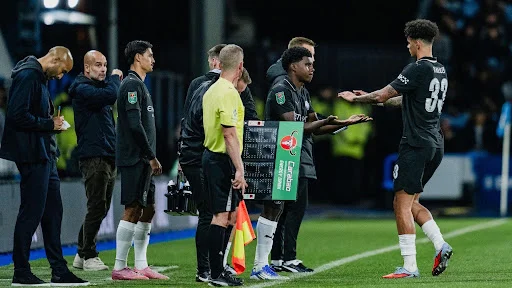
The Carabao Cup third round arrives across the weeks of 7 and 14 September, bringing Premier League clubs involved in Europe into the competition. By then, early league results may appear to offer a useful form guide. Cup football is less straightforward.
Rotation, recovery and squad depth can change a tie within hours. For bettors following the third round through onexbet, recent Premier League results are only part of the picture. A club’s league position says little about whether five regular starters or a heavily changed XI will appear.
A Third Round Full of Premier League Tests
Liverpool host Tottenham, Manchester United face Brighton and Chelsea play Leeds. Arsenal travel to Ipswich, while holders Manchester City host Norwich. Aston Villa go to Coventry, Newcastle visit Millwall, Bournemouth meet Lincoln and Crystal Palace host Middlesbrough.
Teams balancing Champions League or Europa League commitments may protect first-choice players. Others with a free midweek can give minutes to a second striker, young full-back or returning player.
Round two already produced examples. Leeds beat Nottingham Forest 2-0 at the City Ground only three days after the same fixture in the league. Bradford eliminated Burnley on penalties, Brentford scored six against Birmingham and Everton won 4-0 at Preston.
Tottenham beat Charlton 5-1 despite substantial changes, while Chelsea defeated Luton 2-0. League position explained part of those results. Squad depth and selection added another layer.
Why League Form Has Limits in the Cup
Premier League form usually reflects something close to a manager’s preferred XI. The Carabao Cup can instead test the 15th, 18th or 20th player in the squad.
A club performing well might make eight changes. A struggling team could go closer to full strength if the manager wants momentum or sees a realistic route into the next round.
Travel and recovery complicate matters. A midweek trip to Millwall or Coventry after a Premier League fixture differs from a Saturday home game. Lower-league opponents may field their strongest XI while visitors manage minutes around other competitions.
There is another difference: no extra time is played before the semi-finals. A draw after 90 minutes goes directly to penalties, changing the closing stages of a level tie.
Rotation and the Pre-Match Betting Picture
Team news can produce significant price changes. The market an hour before kick-off may look very different from earlier in the day.
Three details are particularly relevant:
- How many likely starters have European commitments that week?
- Does the tie sit beside a Premier League fixture the manager may prioritise?
- Does the stronger club retain a clear quality advantage after rotation?
A +200 underdog shortening after the favourite announces a weakened XI reflects new information rather than league form.
Rotation does not automatically remove the favourite’s advantage. Manchester City against Norwich, for example, would not become an even contest because several regulars were rested. Squad depth can preserve a substantial gap.
That can make handicaps and totals more revealing than simply backing or opposing the favourite.
Goals Markets and Team Selection
A rotated team can make a match more open, but it can also remove attacking quality.
The presence of a recognised No. 9 is one distinction. A midfield-heavy lineup facing a deep Championship defence presents a different goals profile from two Premier League sides using first-choice forwards.
Defensive rotation matters too. Young centre-backs, unfamiliar full-back combinations and reserve goalkeepers can affect total-goals and both-teams-to-score markets even when their club remains favourite.
The In-Play Betting Picture
A goalless first half can expose another difference between league and cup pricing. If a favourite controls possession without creating clear chances, its reputation may keep the live price relatively short.
The bench then matters. A favourite with first-choice attackers available for the final 30 minutes presents a different proposition from one whose strongest options already started.
At 0-0 after 70 minutes, penalties are only 20 minutes away. Substitutions, late corners and next-goal prices therefore sit in a different context from a league match.
The third round will produce results that look surprising beside the Premier League table. Starting XIs, fixture congestion and squad depth may explain why some apparent mismatches are closer than they first appear.