Short performance videos fail in production, not in strategy.
The offer is solid. The angle is sharp. Then it hits the edit stage, and everything slows down. A hook that should take 20 minutes takes 2 days, because someone is stuck matching captions to a voiceover frame by frame.
By the time the cut is ready, the trend it was riding is already dead. Speed isn’t a “nice-to-have” in performance video.
It’s the whole game. Winning ads get tested, killed, or scaled within 48 hours.
A process that can’t produce a clean cut fast enough never gets a fair shot, no matter how good the offer was.
So the real skill isn’t just knowing what makes a good ad.
It’s building a process that goes from offer to finished cut without losing days to editing bottlenecks, so more angles get tested before the algorithm moves on.
Hands-On Workflow: Testing the Offer-to-Ad-Cut Process
To understand this better, it helps to look at a real product example. In this case, we can use Designkit to create ad videos.
Step 1: Shoot one-angle image and lock the offer
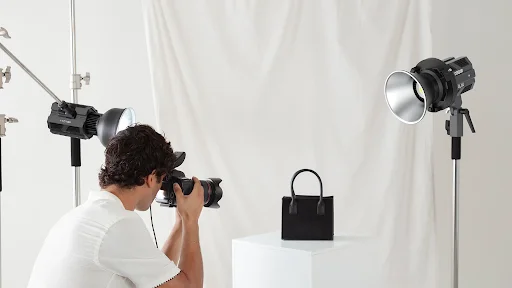
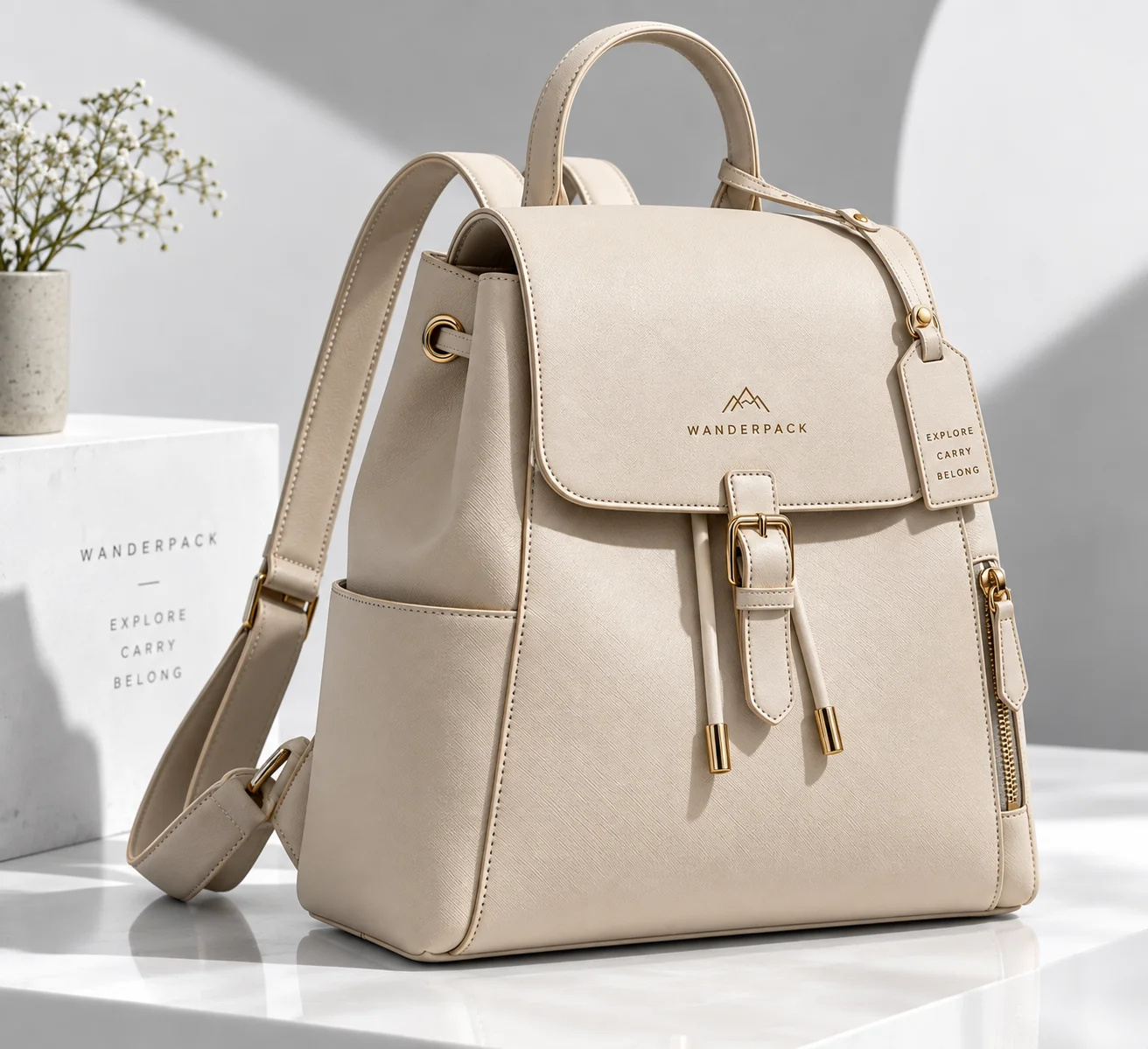
Pick one product shot, not a full shoot. For Wanderpack, that’s a single clean image: the backpack against a white background, well-lit, front-facing, with a little use of props around it. This becomes the anchor visual the tool will build around.
Step 2: Build the message hierarchy
Break the offer into four beats, in the order they’ll appear on screen:
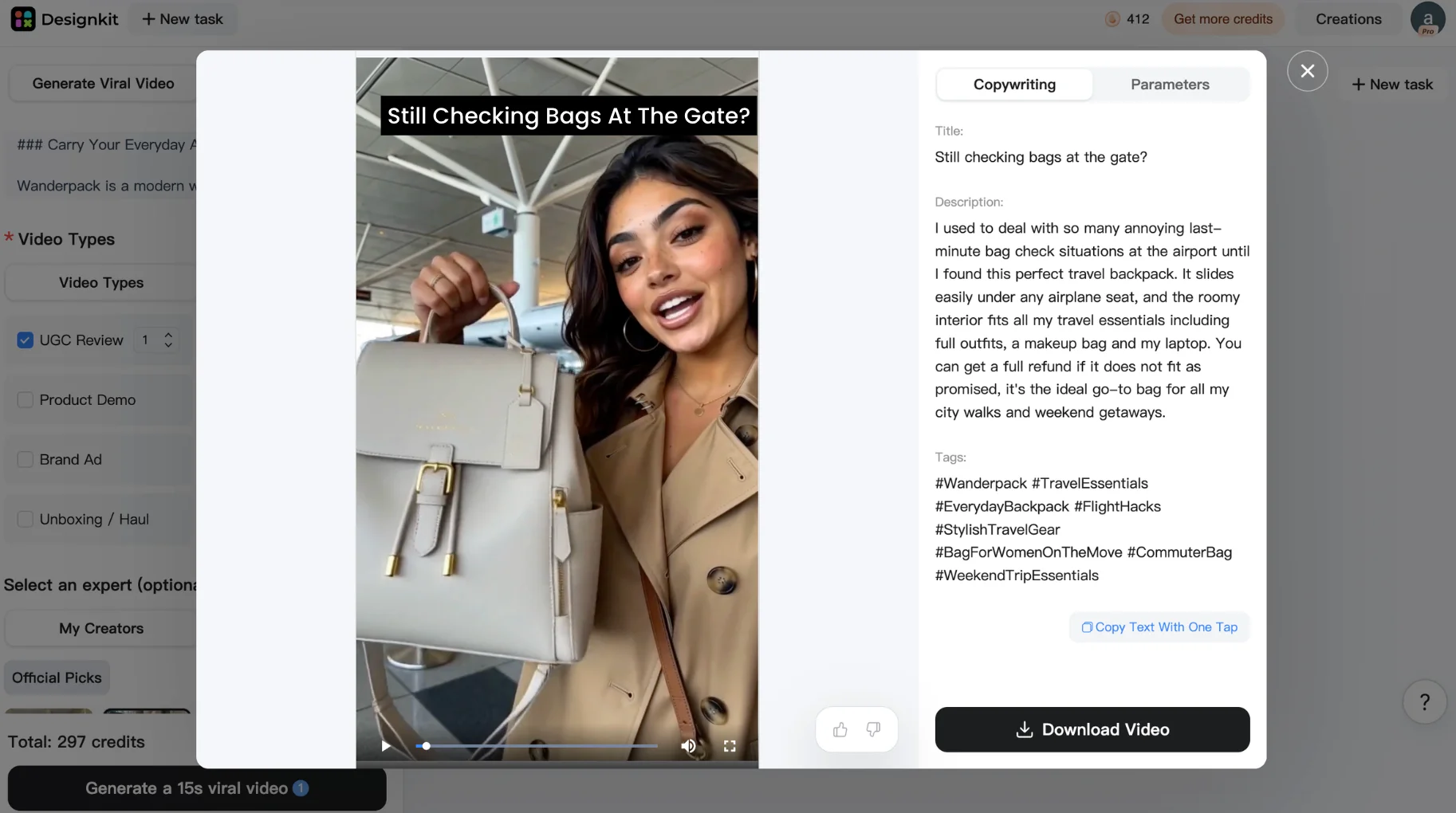
- Hook: “Still checking bags at the gate?”
- Offer: “This one fits under any seat. Guaranteed.”
- Proof: “Backed by a full refund if it doesn’t.”
- CTA: “Shop now.”
Each line gets typed out separately, in order. This hierarchy is what gets handed to the tool next, not a vague brief.
Step 3: Create the video using an AI tool
Upload the product image to Designkit’s video ad maker to begin. This is the point in the process to actually create video ads without touching a timeline manually, and the tool handles every step that follows directly from what gets fed into it.
Once the image is in, paste the four message-hierarchy lines in order: hook first, offer second, proof third, CTA last, so the sequence stays intact.
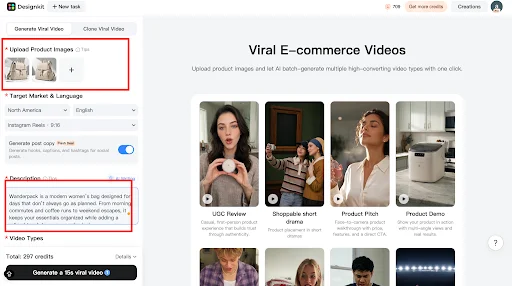
A short product description gets added next, plain facts like water-resistant, fits under most airline seats. This grounds the visuals in what the product actually is, not just what the image shows.
Audience matters as well.
A backpack aimed at solo female travelers reads differently than one aimed at commuters. A single line, “target audience: women who travel solo,” shifts the hook and pacing without needing a rewrite later.
Platform gets locked in last, since aspect ratio and pacing shift between a 9:16 Reel and a square feed placement. With the image, script, description, audience note, and format all set, the tool generates the cut from there.
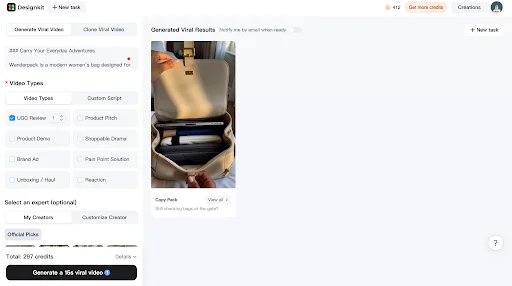
Once these things are locked in, move on to the video type. Since this brand focuses on real pain points of female travelers, UGC is a good option to choose from.
Hit generate and wait for the final video.
Step 4: Reiterate for multiple platforms with different tone and copy
Same hierarchy, same product image, but the tone shifts. For Instagram, the hook stays casual. For a LinkedIn placement (if the brand runs B2B gifting angles), the hook gets rewritten more directly, less playfully.
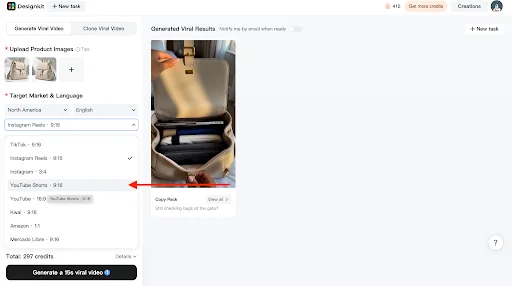
Same four beats, different wording, regenerated per platform.
Hands-on observations on quality:
- Text flow was clean. Line breaks landed where a human editor would place them, not mid-word or awkwardly stacked.
- A bold caption was requested for the CTA line specifically. The output respected that: bold only on the CTA, regular weight everywhere else, no bleed into the other three lines.
- Lighting was specified as “warm, slightly golden” for the proof beat. The generated frame matched that tone without washing out the product colors.
- The backpack in the final cut matched the uploaded reference image closely. Same strap color, same zipper placement, no drift into a generic-looking bag.
Reflecting Brand Personality in the Final Cut
Even though technically everything is done right, the completed video might end up sounding wrong because it will sound unlike the brand creating it.
The product itself must be shown accurately – the same colors, shapes and even details as in the reference picture must be present because people will notice when reality is different from expectations.
However, keep in mind that just as visual elements of the video convey a certain tone and mood, audio should convey the same one.
A high-class or serious brand should be reflected in the music and the voiceover, rather than using happy-go-lucky music just because it sounds good and lively.
It applies to the pace of the video as well.
None of this is about fixing errors.
It’s about checking whether the cut actually sounds and feels like the brand behind it when you create video ads, not just a correct video with the right product in frame.
Common Mistakes and Fixes Before Adopting a Clean Process
| Mistake | What Happens | Fix |
| Chasing production value before locking the offer | Time gets spent on visuals for a message that hasn’t been tested yet | Write the offer in one plain line first; style comes after |
| Testing multiple angles in one video | The viewer gets a mixed signal, no clear reason to stay | One angle per cut, always |
| Skipping the sound-off test | A cut that only works with audio loses most scroll-through viewers | Watch every cut muted before publishing |
| Burying the CTA under a strong visual | Viewers finish the video without knowing what to do next | Keep the CTA visually distinct, even in a busy frame |
| Treating the first generated cut as final | Small tone or pacing misses ship unnoticed | Review the output as a first draft, not the finished ad |
Final Thoughts
The teams pulling ahead aren’t the ones with better cameras or bigger budgets. They’re the ones who shortened the distance between an idea and a live test, from days down to the time it takes to write four lines and press generate.
There’s a quieter shift too.
Decisions that used to live in a strategist’s head- tone, pacing, what a brand would or wouldn’t say- now have to be written down and handed off, since the tool doing the cutting can’t read a room the way a human editor can.
Brand voice stops being a vibe and starts being a checklist someone actually follows. This process isn’t a shortcut. It’s what happens when the repeatable parts get treated as infrastructure, freeing up time for the one thing no tool can do yet. That is: deciding which offer deserves to be tested in the first place.