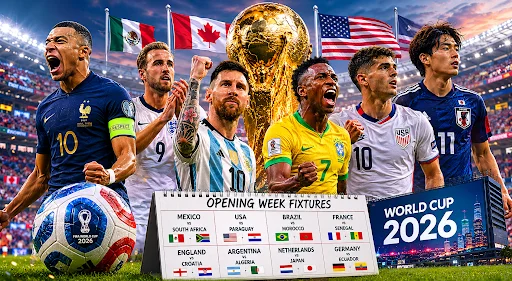
The opening week of a World Cup rarely decides the champion, but it often tells us which teams are ready and which are already chasing the tournament. In 2026, that first week may matter even more. The new 48-team format, the added Round of 32 and the travel demands across the United States, Canada and Mexico mean that every early result could shape the route ahead. Even outside football, in sectors built around forecasting, sponsorship and risk – from media companies to brokers Ireland – the first week will be watched as the moment when assumptions start turning into evidence.
This will be the biggest World Cup ever staged. FIFA’s schedule confirms 104 matches, with the group stage running from 11 to 27 June, followed by the new Round of 32 from 28 June to 3 July. The final is set for 19 July at New York New Jersey Stadium. That longer road changes the value of the first match. It is no longer just about settling nerves. It is about route management, goal difference and avoiding a dangerous early wobble.
The format also makes the group stage slightly strange. The top two teams from each group go through, but so do the eight best third-placed sides. That gives teams a safety net, but it also makes every goal more important. A 1-0 defeat and a 3-0 defeat may lead to very different tournament realities. A draw on opening day might look dull in the moment, then become valuable when the third-place table begins to form.
Why the First Week Matters
In older World Cups, the opening match was often a test of rhythm. Teams wanted to avoid losing, but the structure was familiar. Two teams went through, two went home, and the maths was usually clear.
In 2026, the picture is less tidy. A team can start slowly and still survive, but survival is not the same as control. Finishing second or third may lead to a much harder knockout path. Winning the group may not guarantee an easy road either, but it usually gives a team more authority over its tournament.
That is why the first week matters. It sets the emotional temperature. It shows whether a favourite is calm, whether a host nation can handle pressure, and whether an outsider has enough belief to make the group complicated.
Mexico vs South Africa: The First Night Pressure
The tournament opens on 11 June with Mexico against South Africa at Mexico City Stadium. For Mexico, this is more than a football match. It is the first act of a home World Cup, played in a venue loaded with history and expectation.
Opening games can be awkward for hosts. The build-up is emotional, the crowd expects celebration, and the players have to turn ceremony into football very quickly. Mexico will know that a strong start could give them control of Group A before matches against Korea Republic and Czechia.
South Africa have a different kind of freedom. They can enter the game as the team trying to spoil the party. That makes the opener dangerous. If Mexico start nervously, the whole mood of the group could change before the tournament has properly begun.
Canada and the Proof of Home Advantage
Canada begin against Qatar on 12 June at BC Place Vancouver. This is a different type of host pressure. Mexico carry history. The United States carry scale. Canada carry the question of proof.
Can home advantage really help Canada in a group that also includes Switzerland and Bosnia and Herzegovina? That first match may give the answer. Qatar are not a glamour opponent, but they are not just a ceremonial starter either. They have recent World Cup hosting experience and enough tournament knowledge to make Canada work.
For Canada, three points would change everything. A draw would keep them alive but leave the group tense. A defeat would turn the second match into a rescue mission.
USA vs Paraguay: The Host Nation Under the Brightest Lights
The United States start against Paraguay on 12 June at Los Angeles Stadium. For the tournament’s biggest host nation, this is the first major test of whether the team can turn home attention into momentum. FIFA’s schedule then gives the USA matches against Australia and Turkey in Group D.
Paraguay are the sort of opponent that can make an opening game uncomfortable. They are unlikely to be intimidated by the occasion, and South American sides rarely give favourites an easy night. For the USA, the danger is not only the result. It is the performance.
A confident win would feed the idea of a serious home run. A flat draw would invite pressure. A defeat would make the rest of the group feel much heavier than expected.
Brazil vs Morocco: The First Big Statement Game
Brazil against Morocco on 13 June at New York New Jersey Stadium may be the strongest fixture of the first week. It has name value, tactical interest and real meaning for both sides.
Brazil are always judged differently at World Cups. A narrow win can be treated as a warning. A stylish win can make people talk about them as champions within hours. That is the weight of the shirt.
Morocco, though, are no longer a team that can hide behind the label of surprise. Their 2022 run changed how opponents see them. They are organised, confident and capable of making big teams uncomfortable. If Brazil win well, it will look like a statement. If Morocco take something, it will immediately reshape Group C.
Germany vs Ecuador: Stability Before Style
Germany open against Ecuador on 13 June at Dallas Stadium. On paper, Germany will be expected to take control. In practice, this is exactly the kind of first game that can test a favourite’s balance.
Ecuador can bring energy, physical strength and speed. They are not the kind of side a team wants to face if its midfield spacing or defensive structure is not settled. Germany do not need to be spectacular in this match. They need to look solid.
A calm win would restore the usual tournament language around Germany: efficient, serious, difficult to beat. A messy performance would create questions before matches against Côte d’Ivoire and Curaçao.
Netherlands vs Japan: The Tactical Match to Watch
Netherlands vs Japan on 14 June in Toronto could be one of the smartest games of the first week. It may not carry the same headline weight as Brazil or England, but the football itself could be excellent.
Japan are quick, disciplined and tactically mature. They have shown in recent tournaments that they can trouble teams with bigger reputations. The Netherlands will likely want control, but Japan can punish slow possession and loose transitions.
Group F also includes Tunisia and Sweden, which makes the opener important. A win would give either side breathing room. A draw could leave the group tight from the start.
Argentina vs Algeria: Champions With a Different Burden
Argentina begin against Algeria on 15 June at Kansas City Stadium. As defending champions, Argentina will not be judged like everyone else. Every performance will be compared with memory. Every slow spell will raise the question of whether the hunger is still there.
Algeria are capable of making the match physical and emotional. For Argentina, the key is not only winning. It is showing that they still have the patience and bite of a champion.
If Lionel Messi is involved, the attention will be even greater. But Argentina’s title defence cannot be built on nostalgia. The first week will show whether they arrive as a team still chasing something, or one carrying the weight of what it already achieved.
France vs Senegal: The Favourite’s Hardest Start
France against Senegal on 16 June at Los Angeles Stadium may be the most demanding opener for any leading contender. France have the depth, experience and individual quality to be one of the safest pre-tournament picks. Senegal have the physicality and discipline to make them uncomfortable.
This is not a gentle start. It is a proper test.
If France control Senegal, the rest of the tournament will notice. If Senegal frustrate them or take points, Group I becomes one of the early talking points, especially with Norway also in the section.
England vs Croatia: A Familiar Source of Anxiety
England start against Croatia on 17 June at Dallas Stadium. For England supporters, Croatia are not just another opponent. The memory of the 2018 World Cup semi-final still gives this fixture a sharper edge. England will also face Ghana and Panama in Group L.
This is not the most brutal opening draw, but it is uncomfortable. Croatia know how to stay in games, slow the rhythm and make favourites work. England will be expected to win, but expectation is often the hardest part of an opening match.
A strong performance would settle the mood. A nervy one would invite familiar doubts.
The Second Match Comes Quickly
The first week will not stop with opening fixtures. By 18 and 19 June, several groups move into the second round of matches, including Mexico vs Korea Republic, USA vs Australia and Brazil vs Haiti. That is when the tournament table begins to take shape.
The first game sets the mood. The second game starts deciding the route.
For favourites, this is where goal difference may become important. For underdogs, it may be where one early point turns into real belief. For hosts, it may be where the pressure either lifts or grows.
Final Verdict
World Cup 2026 will not be won in the opening week, but it may be shaped there.
Mexico, Canada and the USA must handle the pressure of hosting. Brazil, France, Argentina, Germany and England must prove they are ready before the knockouts even appear. Japan, Morocco, Senegal and Paraguay can all make the first week more complicated than the favourites would like.
In the new 48-team format, the opening week is not a warm-up. It is the first test of control.