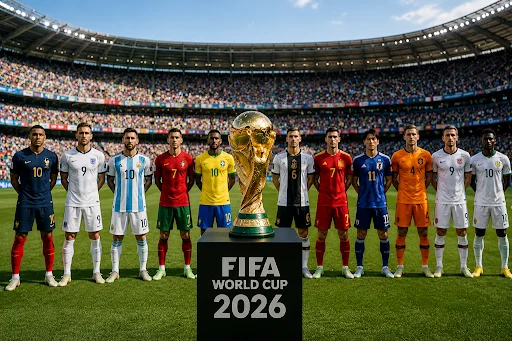
Every World Cup begins with a familiar argument. Not the draw, not the opening game, not even the predictions, but the squads. Who has the best keeper? Who has too many forwards and not enough defenders? Who looks frightening on paper but strangely fragile when you look closer? Ahead of World Cup 2026, that debate feels bigger than usual, because this tournament will ask more from every national team. Analysts, supporters and markets connected to betting in Ireland will all look at the same thing first: which countries actually have enough depth to last the full journey?
The 2026 World Cup will not be a normal 32-team tournament. It will have 48 teams, 104 matches and an extra knockout round. That last part matters. A team trying to win the trophy will need to get through more football, more travel, more recovery days, more pressure, and probably more awkward games than before.
That changes how we should judge the best squads. It is no longer enough to list the strongest starting XI. A beautiful first team can fall apart if two players get injured or if the manager has no useful options after 70 minutes. The best squad in 2026 may not be the one with the biggest star. It may be the one with the smallest drop-off between starter and substitute.
There is also a simple warning: these are squads “on paper”. Final selections can shift. A bad injury in May, a loss of form, a late breakout season, a tactical change – all of it can alter the picture. So this is not a prediction of the official final squads. It is a reading of the strongest player pools and which nations look most complete before the tournament properly begins.
Completeness is the key word. Some teams have brilliant attacks but leave too much space behind the ball. Others have defenders and midfielders who can control matches, but not enough goals. The teams with the best chance are usually the ones that can win in more than one way.
That is true across most forms of sports analysis, whether people are looking at transfer value, tournament odds, team depth or even markets such as serie A betting. Names matter, but balance matters more. A squad is not just a poster of famous players. It is a set of solutions for different kinds of problems.
France Still Look Like the Standard
France are the easiest place to start because their squad does not need much explaining. They have power, pace, experience and enough elite players to survive most normal tournament problems.
Their biggest advantage is not just the first XI. It is the second layer. France can lose a key player and still bring in someone who plays at a high level every week. In a long World Cup, that is a serious weapon. They can also change style without looking lost. They can control a game, counterattack, defend a lead or lean on individual quality when everything else becomes messy.
That is why France look like the most complete squad on paper. Not because they are perfect, but because the weaknesses are harder to find than with most others.
The only obvious danger is the weight of expectation. France will arrive as one of the teams everyone wants to beat. That can make a side heavy. Still, if this is about depth and balance, they are at the top of the list.
England Have the Names – Now They Need the Shape
England’s talent pool is strong enough to win a World Cup. That statement no longer feels exaggerated. The attacking options are deep, the midfield has real quality, and the defence has enough top-level experience to handle difficult games.
The problem is that England have had strong groups of players before. The harder question is always about shape. Which attackers fit together? Who controls midfield when the match slows down? How brave should the team be against another favourite? These are the questions that decide knockout football.
England’s depth could be a huge advantage in 2026. With an extra knockout round, fresh legs from the bench may decide matches. Few teams can bring on players who change the rhythm as quickly as England can.
Still, a squad is not complete just because the names look good. England need clarity. If they find it, they can reach the final. If they spend the tournament trying to solve the puzzle in real time, the same old doubts will return.
Spain Bring Control, and That Could Be Priceless
Spain do not always look as explosive as France or Brazil. They do not always frighten teams in the same obvious way. But they have something that matters just as much: control.
A World Cup can become emotional very quickly. One early goal, one nervous crowd, one strange refereeing call, and a match can turn into chaos. Spain are one of the few teams capable of slowing that chaos down. They can keep the ball, set the rhythm and force opponents to defend for long spells.
That kind of control may be very useful in a 48-team tournament. Some matches will be awkward. Some opponents will sit deep. Others will press wildly. Spain’s technical base gives them a way to handle different situations.
The risk is also familiar. They must turn possession into enough threat. Passing alone does not win knockout games. If Spain are too careful, a single counterattack can undo 80 minutes of control.
Brazil Have the Ceiling, but Do They Have the Balance?
Brazil are never just another contender. The shirt carries a whole history with it. Every World Cup, they arrive with talent, expectation and the belief that something special might happen.
On paper, Brazil’s attacking talent is always frightening. They have players who can beat a defender, change a match with one touch, or make a goal from very little. That gives them a ceiling few teams can match.
The question is what happens behind the glamour. Can the midfield protect the defence? Can the full-backs attack without leaving too much space? Can Brazil manage a tight game against a European side that refuses to open up?
That is why Brazil are high on the list, but not first. Their best version can win the tournament. Their loose version can look wonderful for a while and then disappear in a quarter-final.
Argentina Know How to Suffer
Argentina’s squad may not be the deepest in every position, but they have something more valuable than most: proof. They know how to win this tournament. They know how to survive bad spells, ugly minutes and games that feel like they are slipping away.
That matters. Some teams look better on paper until the match becomes uncomfortable. Argentina are comfortable with discomfort. They can scrap, wait, provoke, defend and strike when the chance appears.
The obvious question is whether the same hunger remains after 2022. Winning a World Cup changes a group. It gives belief, but it can also take away the desperation that pushed the team over the line.
If Lionel Messi is involved, the story becomes even bigger. But Argentina’s strength is not only Messi. Their last World Cup win was built on resilience, timing and emotional control. Those qualities still count.
Portugal May Be the Most Underrated Deep Squad
Portugal have a stronger squad than they are sometimes given credit for. Their attacking options are excellent, the midfield has technical quality, and they have enough experience to handle tournament pressure.
The issue is identity. Portugal have several possible versions of themselves. They can play through possession, attack quickly, use width, or build around creative midfielders. That sounds like a strength, and it can be. But at a World Cup, too many choices can become a problem if the manager does not settle on the right plan.
On paper, Portugal have enough to reach the semi-finals. Maybe more. They are not a sentimental pick or a pure dark horse. They are a serious contender with a squad that can hurt anyone.
What they need is a clean tournament rhythm. If they find that early, they will be difficult to stop.
Germany and the Netherlands Are Close, but Not Complete Enough Yet
Germany can never be dismissed for long. Even when they are not the obvious favourite, they usually have enough technical quality and tournament memory to become dangerous. But right now, compared with France or Spain, there are more questions.
Is the defence stable enough? Is the midfield balanced? Can they control matches without losing sharpness in attack? If the answers are yes, Germany can go deep. If not, reputation will not save them.
The Netherlands are in a similar space. They are organised, strong and rarely easy to beat. They often look like a team built for tournament football. Still, they may lack the attacking certainty of the very top sides.
Both teams belong in the top group of contenders. But “good enough to go far” is not the same as “most complete squad”.
The Balanced Outsiders
Not every complete squad belongs to a favourite. Some teams are dangerous because they know exactly what they are.
Japan are a good example. They are quick, disciplined and tactically sharp. They may not have the same star power as Brazil or France, but they can expose careless teams.
Senegal have physical strength, defensive organisation and enough quality to make bigger names uncomfortable. Morocco have already shown that structure and belief can carry a team deep into a World Cup.
Uruguay and Colombia also deserve mention. They can turn matches into contests that favourites do not enjoy. They may not top a squad-depth ranking, but they are not teams anyone will want to meet early in the knockouts.
Ranking the Most Complete Squads on Paper
A fair pre-tournament ranking would look like this:
| Rank | Nation | Main reason |
| 1 | France | Depth, athleticism, experience and flexibility |
| 2 | England | Strong options across the pitch, especially in attack |
| 3 | Spain | Midfield control and tactical clarity |
| 4 | Brazil | Elite attacking talent and high ceiling |
| 5 | Argentina | Champion mentality and tournament resilience |
| 6 | Portugal | Deep squad with several attacking solutions |
| 7 | Germany | Technical base and tournament history |
| 8 | Netherlands | Organisation and physical balance |
| 9 | Uruguay | Competitive edge and awkward style |
| 10 | Japan | Discipline, speed and tactical maturity |
Final Verdict
France look like the most complete squad on paper. They have the fewest obvious gaps and the strongest mix of depth, power and tournament experience.
England, Spain, Brazil, Argentina and Portugal are close enough to challenge that ranking in different ways. England have options, Spain have control, Brazil have match-winners, Argentina have proof, and Portugal have depth that can trouble anyone.
But the 2026 World Cup will not reward paper strength alone. It will reward the squad that stays fit, calm and useful from the first match to the final week. In a longer tournament, the best team may simply be the one with the fewest cracks showing when the pressure arrives.