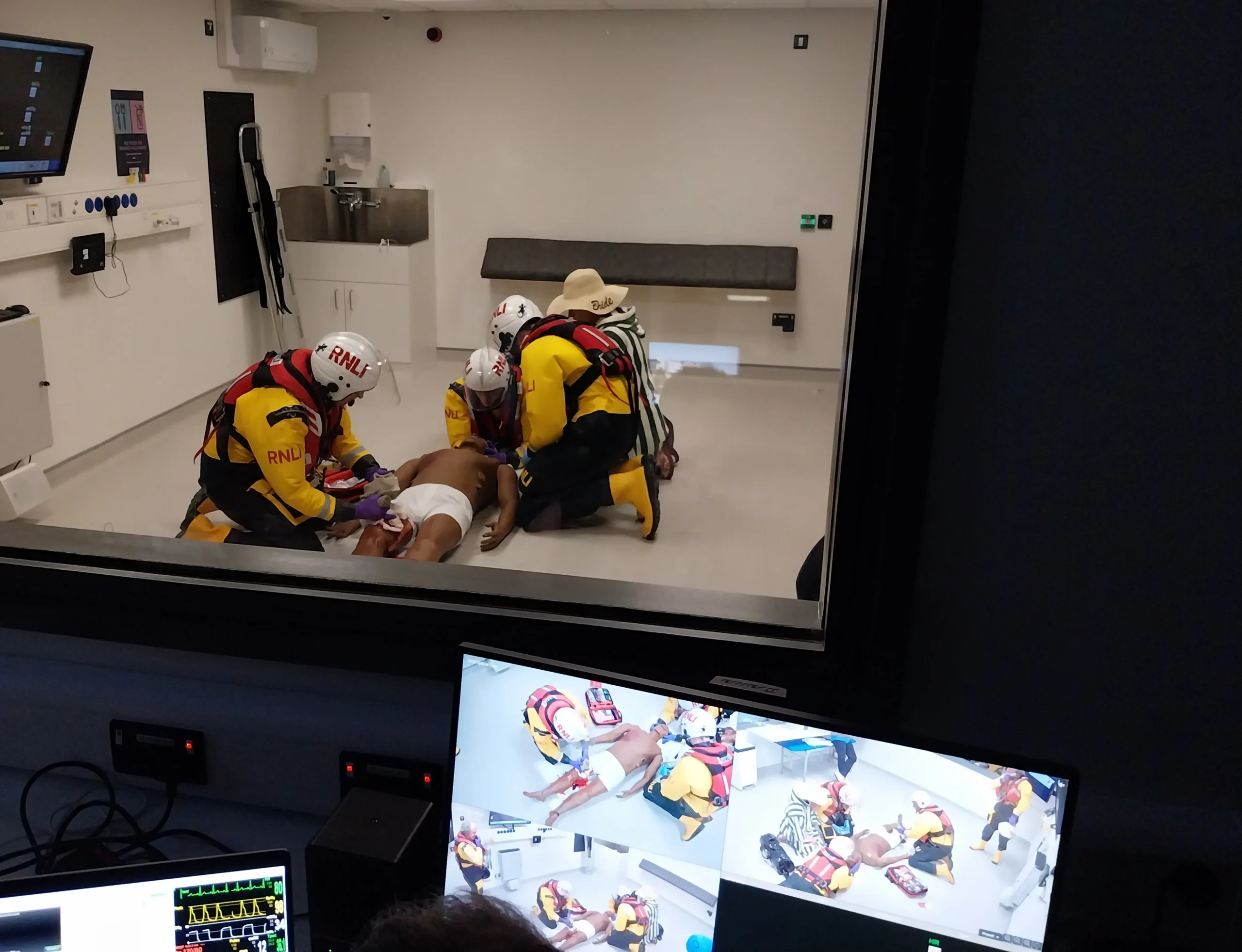
Volunteers at the Galway RNLI have been taking part in training exercises for dealing with severe trauma victims.
Twenty volunteer crew took part in the training exercise at the University of Galway Clinical Simulation and Interprofessional Education Facility at UHG last month.
The training exercise was based on a call out to an injured jet-skier on a remote beach and had been designed by the Irish Centre for Applied Patient Safety and Simulation (ICAPSS) staff to replicate a real-life situation which played out in real time.
Philip Parackal, Clinical Nurse Manager, CNM 3, ICAPSS said, “We have state-of-the-art simulation facilities here in Galway, which is an accredited centre and the recipient of an ASPIRE award.”
“We provide training and education for all levels of medical and clinical staff from students to experienced clinical teams.”
“We use full-body manikins which are programmed by our simulation technicians to show different physiological changes and address differing learning needs.”
“In the case of the exercise with the RNLI crew, we wanted to allow the crew to apply their casualty care training along with using the first aid equipment they carry on the lifeboat while adapting to the environment of the rescue”.
“In our scenario, we had a multi trauma male casualty who sustained injuries during a jet ski accident on the bay. The extensive injuries were simulated by our team using moulage, or SFX makeup.”
“The casualty’s condition deteriorated, and the simulation replicated a cardiac arrest which the crew had to treat actively. The injuries and how the patient would deteriorate was not shared with the crew in advance.”
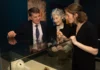
“One of the benefits of the simulation centre is that all of the crew could observe the simulation on a big screen from another lecture room while four crew actively participated in the simulator.”
“This is a benefit in terms of observing and gaining valuable experience in areas such as communication, teamwork, situational awareness, treatment, use of the casualty care check cards and timely transport.”
Brian Niland, volunteer crew with Galway RNLI, took part in the simulation exercise, said, “The full-body manikin we treated was very realistic and was able to talk, bleed, had a pulse and all the human reactions you would expect.”
“When the casualty deteriorated, we were able to practise resuscitation techniques on the manikin, which was programmed to simulate the very specific conditions that casualties we rescue are exposed to, such as water and cold.”
“We also had to simulate transporting a casualty with a traumatic leg injury, head injury and who had been in cardiac arrest. All of our casualty care training and equipment was put into use.”
Nurse Olivia Byrne is also a volunteer RNLI crew member, and leads out on first aid exercises at the lifeboat station.
“The simulation exercise was part of ongoing engagement between the University of Galway’s School of Medicine, Nursing and Health Sciences and the RNLI crew.”
“The facility enables us to put our crew in a very realistic multi trauma scenario and practise skills such as assessment of the casualty through the use of check cards, communication skills and procedures for handover to the paramedic service.”
“As a crew we found the debrief following the simulation in particular to be very positive from Philip and his colleagues, and reiterates the wonderful facility the ICAPSS centre is and the role it plays in patient care and promoting patient safety.”